Wednesday, October 11, 2017

I'd Walk a Mile for a Camel?

Okay, when they told us there would be sand dunes in Dunhuang, I was picturing the dunes I'd seen before--maybe 40-50 feet high. These Gobi desert dunes were MASSIVE at about 600 feet high, at least. Because it was "golden week" holiday in China, we were not the only ones there. There were perhaps 500 camels either resting or carrying passengers up and down the dunes. It was a bonding experience between "master" and animal. I now feel close to "Fred," and empathized with his pain as he lugged all my weight up the steep dunes. At one point, he decided to take a short break without telling me and knelt down using his front knees. We rode for about an hour before I came to a realization . . . Confucius could have said, "He who rides too much on camel becomes Soprano in choir." We wanted to ride an ultra-light aircraft after the camel ride, but did not have enough time.

What a blast, though!

That's not a mountain ahead, that's just a sand dune! The Gobi Desert is amazing

Laraine, all set to start her camel journey. She's already jealous of the camel's long eyelashes.

These are a few of the camels who are resting. I'm sitting on one of them, ready for lift off.

I was the caboose on a 5-camel team. this was my view as we started out.

Doing a selfie is hard because you kind of need both hands to hang on to the camel.

Camel ride done, we're off to the oasis "Crescent Lake." Those are sledders in the distance.


The orange foot coverings are to minimize contact with the sand. Kind of an odd thing to do in the desert.

This is part of the oasis, a pagoda, with a "short" dune (maybe 200-300 feet high) in the distance. The lake is just behind this pagoda. 


Sleeper Train

We've always wanted to experience riding a sleeper train. It was a lot of fun. Traveling overnight from Turpan to LiuYuan station (near Dunhuang), we shared our compartment with Neal and Jolene Thompson from New Mexico who are teaching in Tian Jin. He is about 6'6" and I felt sorry for him, trying to scrunch into a 6' compartment. Surprisingly, no one snored -- at least that I heard. The train made several stops and the bed was hard . . . hard.

Laraine slept well.

I (Chuck) forgot to check the latch on the door to know how to open it in the darkness. As usual, I got up once in the middle of the night to use the bathroom and because I had forgotten to see how the latch works, I stood there jiggling and pushing the latch. After a while, I heard a male voice on the other side of the doorway, in the outer hall say, "Just pull it towards you." It was Tim Pelton, another China teacher who teaches at Beijing University. He was standing out in the hall with several other  men from our group, all waiting for the bathroom. It was kind of surreal.

At 8:30 a.m., when we arrived in LiuYuan, a tiny town in "Black Gobi" where the dirt is black from minerals, we had to wait for another train carrying the rest of our group. But we had no bathroom, and because we had already exited the station, we could not convince both sets of security guards (it was a two-layered system--get through one checkpoint, then walk about 50 feet and do it all over again with a second checkpoint) to allow us back in without a "valid ticket." Showing our just-used ticket didn't work. So a few of us were desperate for a bathroom and we walked across the street to a hotel called the "Grain and Oil Hotel" (I'm not kidding). They informed us they had no bathrooms for non-guests. But just then, a Chinese couple from Beijing walked through the lobby and invited us up to their room to use their toilet. What an amazing couple. The problem was that three people turned into 5, then 7, etc. We thanked them profusely.

About 90 minutes from this little train station was a town called Dunhuang. It was an incredible place . . . huge sand dunes, camel rides, and more. . . 

Roommates--Jolene and Neil Thompson on Sleeper Car between Turpan and LiuYuan, China. They were great roommates. We had no problem with them, as they kept the partying to a minimum. 


An Effort as big as the Great Wall

In the Gobi desert, we learned of a massive, ancient public works project as big as the Great Wall. Because the Gobi desert climate is so dry, relying on snow-fed mountain streams for crops was unthinkable. The ancient Chinese desert dwellers dug over 17,000 vertical shafts and then climbed into those shafts to dig slanted underground canals, some as long as 15-16 miles. These canals allowed water to travel the distances needed to bring life-giving water to the people without worrying about evaporation.

We also learned the legend of the Flaming Mountain, when a priest made a journey to the west, crossing the hot mountain, borrowing a magical fan from a monster woman. From this story came four archetypes, representing four different kinds of personalities--one of which is a monkey king and the other a pig monk. Our visit to Flaming Mountain during China's "golden week" included a visit from these two characters. Chinese flock to this mountain like Americans go to Disneyland to see the mythical creatures there.

We also visited a Muslim minaret in the desert and got up close with the burial rites.

Checkpoint into the Canal System Exhibit. Notice anything different about the police officer?

We've never seen a police officer in high heels.

A vertical shaft dug to lower workers into the canal

The way they lowered workers into the canal system.

Underground water flowing.

I'm getting the better of him, right? Right? 
Flaming Mountain exhibit. Thousands of Chinese tourists here to see this mountain.

Laraine caught herself a pig monk, and the monkey king is right behind her. Flaming mountain background.

Monkey King

Commemorating the mythical story
Arriving at the Minarett


Prayer area.

When you kneel to pray, don't go falling down in any old way, do it carefully.

The different shapes denote whether the person buried was a man or a woman.

A blanket covering either an altar or a coffin, with offerings in the corner. 

Native Life in a Uyghur Village

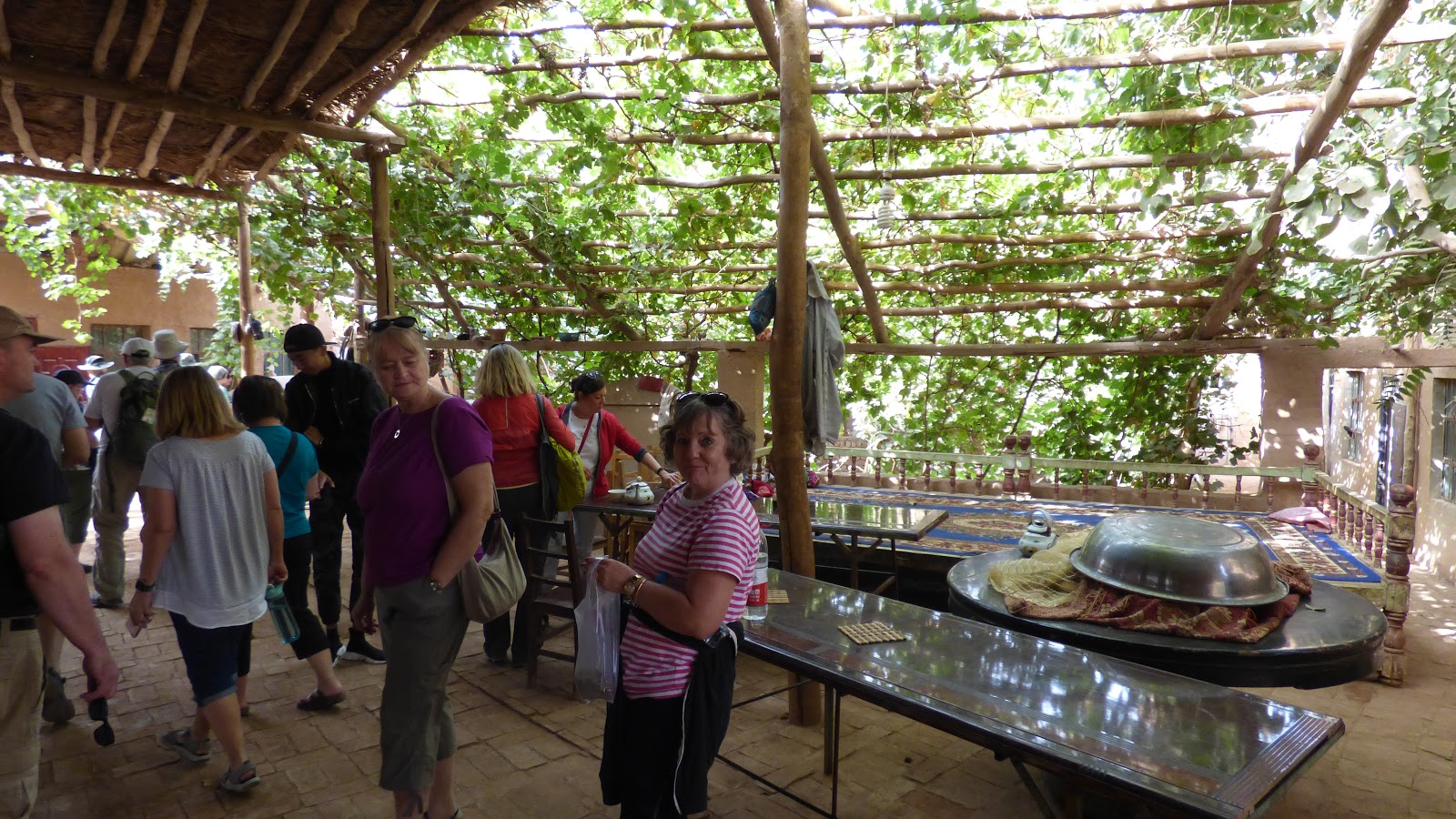
We got to walk around a quaint Uyghur Village. The Uyghur people were warm, sweet, and very grateful for whatever we would purchase from them. We bought raisins and more raisins. After purchasing from one woman, she showed us in her house, surprising her grandsons who were watching TV. They have very large carpet-covered "beds" or platforms on which they sleep and/or eat. The woman grabbed some long, spiraled french-fry-type food that she then shared with us and insisted that we share with our group. It was an amazing experience.

Looking down on the Uyghur village, with vineyards and chicken coops galore. It is at the foot of the Famous Flaming Mountain

The village mosque

Everywhere we went, the villagers stockpiled things on top of their flat roofs. Sometimes it was firewood and sticks, or it was discarded appliances, and old bed frames.

Every village has at least one "police station in a box" and this one also happened to have a nice statue out front. 

Don't look at me, look at the mountains behind. Very devoid of vegetation or many other features.

This is the woman who invited us into her house.

Sweet woman looking at me . . . looks familiar.

This man was sitting there, contemplating what he was seeing on his smartphone . . middle of nowhere.

Two sweet women. One of them grows raisins, the other doesn't.

Inside the family kitchen.

A bedroom.

We still not sure what it was she shared with us. Some kind of french-fry food.

Her grandson was a moving target

Laraine takes a rare break from looking around to be photographed

Dried Cantaloupe. It is pretty good, but can also be sicky sweet or extremely bitter.

When we first read this plaque on the building, we thought they were honoring Albert von Le Coq. It turns out, they are calling him out for stealing cultural relics, bringing great damage to their community. 

Someone needs to contact Albert von Le Coq's family and see if they can return the relics he stole from this village. This is the home he stayed in while he stole pottery, woodware, Confucion artifacts, etc. 

Notice the prevalence of wagon wheels? We thought we were in southern Utah.

Another sweet woman--vendor of dried fruit.

Some narrow streets in the village

In an old cemetary

Part of the cemetery in the village